
“Have you ever wondered how, when you search for your favorite product on Google, your favorite top-rated website appears in the search results?”
That’s not magic — it’s SEO at work.If you are new to this concept and want to understand what is SEO, here’s the simplest explanation:
SEO, or Search Engine Optimization, is what helps websites like your favorite brands show up when you search online.
Through SEO, Google connects your search queries with the websites that offer the best answers or products.
SEO is an Organic marketing process where you can get leads through your website without paying money to Google.
If you’ve ever asked yourself how does SEO work, this is the core idea — Google scans millions of pages and chooses the most relevant and optimized ones to show you.
It is a strategy where websites need to be optimized for both Google & your audience. The goal is for your website to be visible to a wider audience & drive organic traffic to the site.
So, in this article, I will cover everything about SEO & how to become an SEO Expert throughout this blog. Very few people discuss this technique.
First, we need to understand the various types of SEO that exist in the world. Mainly, 4 types of SEO exist, but people are adding more to this list.
First discuss,
What are the 4 types of SEO?
Let’s take a good example
Think of SEO like running a big restaurant.
On-Page SEO is the chef who makes sure every dish ( your content, keywords, and titles ) is tasty and well-prepared for visitors and search engines.
Off-Page SEO is the marketing manager who spreads the word, getting good reviews and recommendations (backlinks) that make your restaurant popular.
Technical SEO is the kitchen engineer who keeps the lights on, the ovens hot, and everything running smoothly so customers don’t leave because of slow service.
Local SEO is the friendly host who helps nearby people find your restaurant on Google Maps or local listings.
Now describe each part in depth:
On Page SEO or Content Optimization :
If you want to understand how does SEO works, this is one of the most important layers — giving Google clear signals through your content.
On-page optimization is the process to tell your audience & google about your website. The goal is to provide useful content that the user actually needs. If this content is helpful, Google will show your result on the first page. dont publish unnecessary content. Content should be relatable to your site. On-page SEO is like decorating your shop window — it tells both your audience and Google what your store is all about.
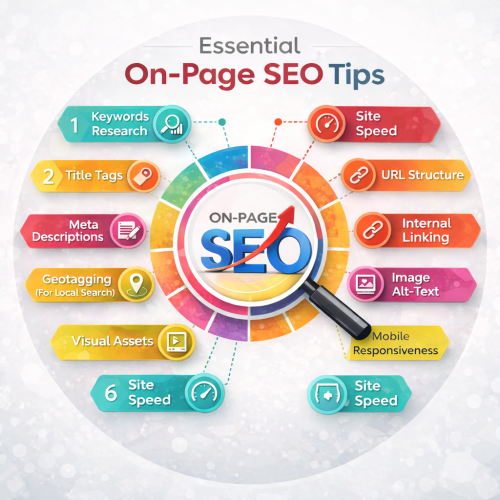
Key Elements of On-Page SEO
Meta Title or Meta Tag: A Meta tag is the HTML element of your website on every page. Let’s say you have a website & this website has 20 pages. So you have to write different titles for every page. It defines what your page is about. Most important is the home page & other product or services pages’ meta title. It should encourage people to click on it.
Meta Description: Like the meta title, a meta description is the HTML element of your website that provides users with what the page is about. It helps users decide whether the page is what they’re looking for by providing a brief overview of its content. You have to write a different description for every page. Think of it as a free ad for your website on Google.
Header tags (H1 to H6)
HTML elements ((h1) to (h6) known as header tags (or heading tags) are used to establish headings and subheadings on a webpage, giving the text a hierarchical structure.
Because they make it easier for users to scan information and for search engines to comprehend its structure and significance, they are essential for both user experience and SEO. The primary title goes with a (H1) tag, the main subheadings with a (H2) tag, and so on down to (H6).
ALT Text for Images
For viewers who are unable to see an image, like those who use screen readers, alt text serves as a digital substitute by providing descriptive text for the image. It is used as the alt property in the HTML image element, giving visually impaired people important context, and aids search engines in comprehending the image content for improved search results.
Internal Linking
The process of connecting different pages on the same website with hyperlinks is known as internal linking. These links help user navigation and aid search engines in comprehending the hierarchy and structure of the website, both of which are helpful for search engine optimization (SEO).
Off-Page SEO
Imagine you’ve just opened a beautiful bakery. The cakes are delicious, the aroma fills the air — but your shop is tucked inside a quiet lane. Hardly anyone knows it exists.
So, what do you do? You start spreading the word. Food bloggers write reviews about your bakery, customers share photos on Instagram, local magazines feature your story, and people start recommending you to their friends. Slowly, your bakery becomes the talk of the town.
That’s exactly what Off-Page SEO does for your website.
It’s all about building your reputation and credibility outside your website. When other trusted websites talk about you, link to you, or mention your brand, Google sees that as a signal — that your website is reliable and valuable.
In short, Off-Page SEO is digital word-of-mouth.
It’s not about what happens on your site, but what people say about it around the web — through backlinks, mentions, reviews, and shares.
Technical SEO
Technical SEO is the process of improving a website’s crawlability, indexability, and overall visibility in search engine results pages (SERPs) by optimizing its technical elements, including its architecture, code, and site speed. When you build a website, your website hosting should be good so that your website loads easily. It’s just not about hosting; it can be your image size or code issue or robots.txt file, or sitemap. It can be anything that slows your site on Google. It reflects a bad experience for the user.
If you ever thought how does SEO work behind the scenes, this is it — the technical foundation.
Local SEO
The technique of enhancing a company’s online presence to increase its visibility in location-based searches, such as “near me” queries or searches that include a city name, is known as local SEO. Targeting regionally relevant traffic that has a higher chance of becoming clients sets it apart from traditional SEO. Optimizing a Google Business Profile, managing online reviews and local citations (such as directory listings), and creating local content are crucial elements of local SEO. If you have a business in your location, then you should create a GMB(Google My Business profile).
I hope you understand these 4 types of SEO
How to start SEO for beginners
When you start learning what is SEO as a beginner, first spend time on google.
Now you think how can i understand from google.
Take any niche (category) or any business or anything you like to search on Google. Put related keywords when you search on those topics. Then you can see lots of search results appear on the SERP (search engine results page).
Then notice their title & description & open the website one by one and read their content.
With this practice, you actually learn how to write meta title, description & content.
Then try to focus on what keywords they are using. If you dont understand the keyword, then read about “keywords” in this blog – keyword blog link.
Practice this suggested website research to make you a good observer & SEO learner every day.
Now the most important thing is to create your own blog site. I know that as a beginner, this part may not be friendly to you. You can start a blog through a free website (Blogger, Weebly). Through this process you learn how does SEO work
Here you can write content & post it on Google.
After writing content, you have to publish your blog on Google Search Console.
Without publishing the website on the search console, Google can’t see your site.
Find a helpful video about Google Search Console on YouTube for how to publish a website on Search Console.
Now you are ready to publish a blog on your site. With this method, you actually learn real-world SEO.
How does SEO work?
It’s important to understand how SEO works on Google.
When you put your website on Google, the search engine crawls your site. After crawling your site, Google processes the page’s content and determines its meaning and relevance.
Then Google indexes this text & stores this content in Google’s own server.
When a user searches then Google shows the result according to search intent.
Which Tool is Best for SEO?
There are a lot of SEO tools in the market, but here I discuss some important tools that you can use on a day-to-day basis
Free Tool
Google Keyword Planner – Google Keyword Planner is a free tool where you can research keywords. You don’t need to pay money to Google. If you are a beginner, then you can use this tool for SEO.
Google Search Console – A free tool where you can monitor your website traffic. Identifying errors & which keyword is getting impressions & clicks.
Google Analytics – A free tool where you can see where users came from & identify traffic sources, and analyze user behavior. Track marketing effectiveness
Paid Tool
SEMrush – This tool helps you in Keyword Research, Competitive analysis, website audit, and rank tracking & many more.
Ahrefs – This tool works the same as SEMrush.
These two tools give you full website performance data, you don’t need to go to another site. I hope you understand what is SEO & how does SEO work on google through this blog.
& that’s it
See you in the next blog and thank you for reading this blog.

Mousumi is the founder of Keenrank and freelance digital marketing & UI/UX specialist with hands-on experience helping startups and growing businesses build visibility, traffic, and conversions online. She has worked with early-stage startups, SaaS companies, and service-based brands, supporting them across SEO, PPC, graphic design, content strategy, and user experience design.
Connect Today for Marketing & Design Work:
Call: 6290577736